
Search is changing fast.
People are no longer relying only on Google to find information. They are increasingly asking AI platforms such as ChatGPT, Google AI Overviews, Microsoft Copilot, and Perplexity to research products, compare services, find businesses, and answer complex questions.
This creates a new opportunity for website owners: getting their content discovered and mentioned in AI-generated answers.
But ranking in AI search isn’t simply about stuffing your pages with keywords. AI systems need to understand your content, determine whether your website is trustworthy, and decide whether your information is useful enough to include in an answer.
So, how do you rank your website in AI searches?
Let’s break it down.
What Is AI Search Optimization?
AI search optimization is the process of improving your website so that AI-powered search engines and answer engines can easily discover, understand, trust, and reference your content.
Traditional SEO focuses heavily on ranking webpages in search engine results pages (SERPs).
AI search optimization goes one step further.
Instead of asking:
“How can I get my page to rank #1?”
You should also ask:
“How can I make my website a reliable source that AI systems want to mention?”
This approach is often associated with terms such as Generative Engine Optimization (GEO), AI SEO, Answer Engine Optimization (AEO), and Large Language Model Optimization (LLMO).
Why Ranking in AI Search Matters
Imagine someone asks an AI assistant:
“What is the best digital marketing agency in Delhi for SEO and social media marketing?”
The AI may provide a short list of agencies instead of displaying ten blue links.
If your company isn’t represented in those answers, you could miss potential customers—even if your website ranks reasonably well in traditional search.
AI search can influence:
- Brand visibility
- Website traffic
- Lead generation
- Online reputation
- Product discovery
- Local business visibility
- Brand authority
This is why businesses should start optimizing for both traditional search engines and AI-powered search experiences.
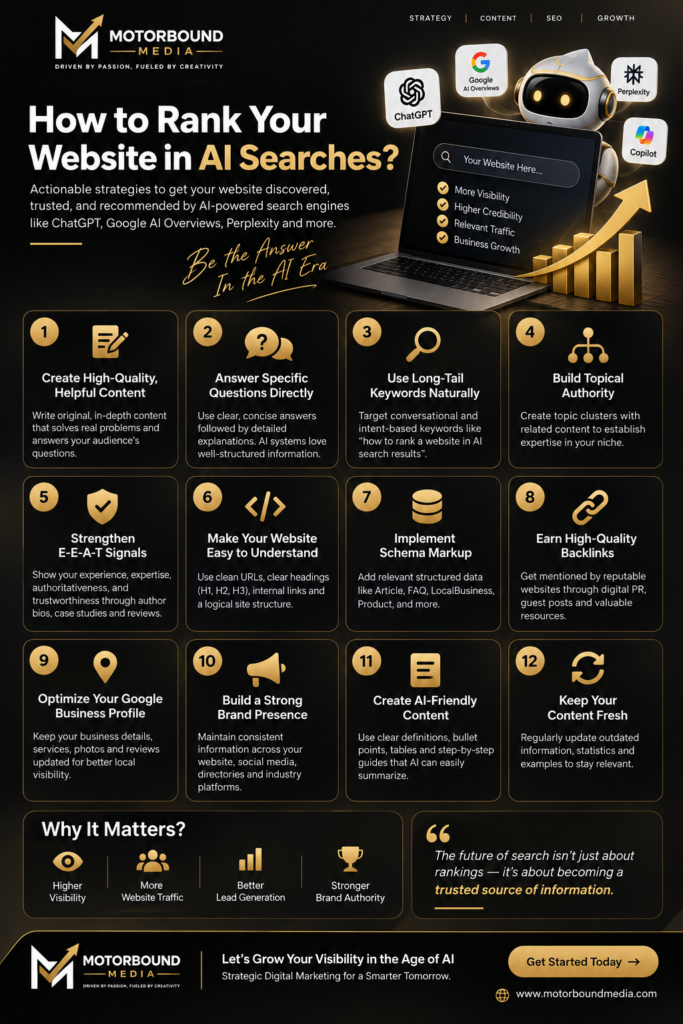
How to Rank Your Website in AI Searches
1. Create High-Quality, Helpful Content
The foundation of AI search optimization is still good content.
AI systems need useful information to answer users’ questions. If your website provides clear, accurate, original information, it has a better chance of becoming a useful source.
Instead of creating articles simply to target keywords, focus on solving real problems.
For example, rather than writing:
“SEO Services – Best SEO Company – SEO Agency – SEO Expert”
create a detailed resource such as:
“How to Improve Local SEO for a Small Business: 10 Practical Strategies”
Cover the topic thoroughly and answer the questions your target audience is actually asking.
Long-tail keyword example:
“how to improve local SEO for a small business in Delhi”
Long-tail keywords can help you target specific search intent while naturally creating content that answers detailed questions.
2. Answer Specific Questions Directly
AI search is heavily question-driven.
Users ask things like:
- How does SEO work?
- How can I rank my website on Google?
- What is the best SEO strategy for a small business?
- How much does digital marketing cost in India?
- How can I optimize my website for AI search?
Your content should provide clear answers.
A useful structure is:
Question
How long does SEO take to show results?
Direct answer
SEO typically takes several months to produce meaningful results, although the timeline depends on competition, website authority, technical health, content quality, and the strategies being implemented.
Then expand on the answer with supporting details.
This makes your content easier for both users and search systems to understand.
3. Use Long-Tail Keywords Naturally
Long-tail keywords are especially useful for AI-focused content because conversational searches tend to be more specific.
Instead of targeting only:
AI SEO
consider targeting variations such as:
- how to rank a website in AI search results
- how to optimize a website for AI search engines
- how to get your website cited by AI search engines
- how to improve website visibility in ChatGPT search
- how to optimize content for Google AI Overviews
- best AI search optimization strategies for businesses
- how to optimize website content for generative search
- how to rank a website in ChatGPT and Perplexity
- how does AI search optimization work
- how to get mentioned in AI-generated search results
Don’t force these keywords into every paragraph.
Use them where they naturally match the search intent.
4. Build Strong Topical Authority
One article usually isn’t enough to establish expertise around a subject.
Suppose you run an SEO agency.
Instead of publishing one article about SEO, create a collection of interconnected resources:
Main Topic
SEO Services
Supporting Topics
- What is SEO?
- Technical SEO guide
- Local SEO guide
- On-page SEO
- Off-page SEO
- Keyword research
- Link building
- SEO for small businesses
- SEO reporting
- AI SEO
- Google AI Overviews
- Generative Engine Optimization
This creates a topic cluster.
When multiple high-quality pages cover related subjects, search engines and AI systems can better understand what your website specializes in.
5. Strengthen Your E-E-A-T Signals
Trust matters.
Google’s search guidelines emphasize Experience, Expertise, Authoritativeness, and Trustworthiness (E-E-A-T), and these principles are highly relevant when creating content intended to be surfaced in AI-driven search experiences.
Show readers that real people with relevant knowledge are behind your content.
You can strengthen these signals by including:
- Author information
- Author credentials
- Company information
- Case studies
- Original research
- Statistics with credible sources
- First-hand experiences
- Expert opinions
- Customer reviews
- Testimonials
- Clear contact information
- About Us pages
Don’t simply claim that you’re an expert.
Demonstrate it through your content.
6. Make Your Website Easy for AI to Understand
AI systems need to interpret your website’s content.
A technically clean website makes this easier.
Pay attention to:
Clear headings
Use a logical hierarchy:
H1 → H2 → H3
Avoid using headings randomly.
Descriptive URLs
Prefer:
/ai-search-optimization/
over:
/page?id=12345
Internal links
Connect related pages using descriptive anchor text.
For example:
AI SEO strategies
is more informative than:
click here
Structured content
Use:
- Bullet points
- Tables
- Lists
- FAQs
- Definitions
- Step-by-step instructions
Well-structured information is easier to scan and interpret.
7. Implement Schema Markup
Schema markup provides structured information about your webpage.
Depending on the content, relevant schema types can include:
- Article
- Organization
- LocalBusiness
- Product
- Service
- FAQPage
- BreadcrumbList
- Person
- Review
Schema doesn’t guarantee that your content will appear in AI answers.
However, accurate structured data can help search engines better understand entities, relationships, and page information.
Important: Your structured data should accurately represent visible content on the page. Don’t add misleading or irrelevant schema simply to manipulate search results.
8. Earn High-Quality Backlinks and Mentions
Authority isn’t built only on your own website.
When reputable websites mention and link to your business, they can reinforce your online authority.
Focus on earning relevant links through:
- Digital PR
- Industry publications
- Guest contributions
- Original research
- Expert interviews
- Case studies
- Partnerships
- Useful resources
- Data-driven content
The goal isn’t to collect hundreds of random backlinks.
The goal is to become a recognized entity within your industry.
For example, if multiple trustworthy websites consistently discuss a company as a leading SEO agency, that broader web presence can contribute to how search systems understand the company.
9. Optimize Your Google Business Profile for Local Visibility
If your business serves a particular city or region, local SEO becomes extremely important.
Keep your Google Business Profile accurate and updated with:
- Business name
- Category
- Address or service area
- Phone number
- Website
- Business hours
- Services
- Photos
- Reviews
Also maintain consistent business information across relevant online directories.
For a local business, your goal isn’t only to rank your website.
You want search systems to clearly understand:
Who you are + what you offer + where you operate.
10. Build a Strong Brand Presence Across the Web
AI systems don’t only look at isolated webpages.
Your broader digital presence can matter.
Make sure your business information is consistent across:
- Your website
- Google Business Profile
- Industry directories
- Business publications
- Social media
- Review platforms
- Relevant third-party websites
For example, if your company name, services, location, and description vary dramatically across different platforms, it becomes harder to establish a consistent digital identity.
11. Create Content That AI Can Easily Quote or Summarize
Think about how an AI system might use your content.
If your article contains a concise, factual explanation such as:
“Technical SEO is the process of improving a website’s technical infrastructure so search engines can crawl, understand, and index its pages more effectively.”
it’s easier to understand and summarize than a paragraph filled with vague marketing language.
Use:
- Clear definitions
- Concise explanations
- Original statistics
- Step-by-step processes
- Comparisons
- Examples
- Expert insights
Give AI systems something useful to work with.
12. Keep Your Content Fresh
AI search is evolving quickly.
Your content should evolve too.
Regularly review important pages and update:
- Outdated statistics
- Old examples
- Broken links
- Outdated strategies
- Product information
- Industry developments
- Screenshots
- References
Don’t change the publication date simply to make an old article appear fresh.
Instead, make meaningful improvements.
AI Search vs Traditional SEO
AI optimization doesn’t replace SEO.
It expands it.
| Traditional SEO | AI Search Optimization |
|---|---|
| Rankings | Mentions and citations |
| Keywords | Search intent and entities |
| SERPs | Conversational answers |
| Backlinks | Authority and web mentions |
| Click-through rate | Visibility within AI responses |
| Webpage ranking | Source selection |
| Search queries | Natural-language questions |
The strategies overlap significantly.
Technical SEO, helpful content, authority, internal linking, backlinks, and strong user experience remain important.
The difference is that AI search adds another layer of visibility to your SEO strategy.
Common Mistakes to Avoid
Keyword Stuffing
Repeating “AI SEO” dozens of times doesn’t make content more relevant.
Write naturally.
Publishing AI-Generated Content Without Review
AI can help with research and drafting, but blindly publishing generic AI-generated articles can result in repetitive, inaccurate, or low-value content.
Add:
- Original insights
- Real examples
- First-hand experience
- Data
- Expert commentary
Creating Hundreds of Low-Quality Pages
More content doesn’t automatically mean more visibility.
One genuinely useful article can be more valuable than dozens of thin pages.
Ignoring Technical SEO
Amazing content won’t help much if search engines struggle to crawl or index your website.
Chasing Every New AI Platform
Don’t build your entire strategy around one platform.
Focus on fundamentals that improve your overall digital presence.
A Practical AI SEO Strategy for Your Website
If you’re starting from scratch, follow this process.
Step 1: Audit Your Website
Check:
- Indexability
- Page speed
- Mobile experience
- Internal linking
- Metadata
- Structured data
- Content quality
- Backlinks
- Brand mentions
Step 2: Identify Your Core Topics
Determine the subjects you want your business to be known for.
Step 3: Research Long-Tail Questions
Find the questions your target customers ask.
Step 4: Create Comprehensive Content
Develop useful pages that answer those questions better than existing resources.
Step 5: Strengthen Internal Linking
Connect related content into logical topic clusters.
Step 6: Build Authority
Earn backlinks, mentions, reviews, PR coverage, and industry recognition.
Step 7: Improve Entity Signals
Make your company information consistent across important online platforms.
Step 8: Monitor AI Visibility
Periodically search relevant questions across AI search platforms and see whether your business or content is being mentioned.
Frequently Asked Questions About AI Search SEO
Can SEO help my website appear in AI search results?
Yes. Many traditional SEO fundamentals—such as crawlability, quality content, topical relevance, authority, and structured information—remain useful for AI search visibility.
However, AI search doesn’t operate exactly like traditional ranking systems, so there is no guaranteed formula for being mentioned.
How do I get my website cited by AI search engines?
Create authoritative, accurate, well-structured content that directly answers relevant questions. Build your site’s reputation through quality backlinks, reputable mentions, original information, and strong topical authority.
What is Generative Engine Optimization?
Generative Engine Optimization (GEO) refers to strategies designed to improve a brand or website’s visibility within AI-generated answers from generative search and answer engines.
Does schema markup help with AI search?
Schema markup can help search engines understand your content and entities. It should be implemented accurately, but it isn’t a guarantee that an AI system will cite or recommend your website.
Are backlinks still important for AI search?
Backlinks remain an important part of establishing website authority, particularly when they come from relevant and reputable websites. However, AI visibility depends on multiple factors rather than backlinks alone.
Can small businesses rank in AI searches?
Yes. Small businesses can improve their chances by developing strong local SEO, creating highly relevant content, establishing topical authority, maintaining accurate business information, and earning credible online mentions.
Final Thoughts: The Future of Website Visibility Is More Than Rankings
The future of search isn’t simply about getting your webpage into position #1.
It’s about becoming a trusted source of information.
If someone asks an AI system about your industry, product, service, or company, you want your website to be among the sources that system can confidently understand and reference.
That requires a long-term strategy built around:
Helpful content + Technical SEO + Topical authority + Structured data + Brand authority + Quality backlinks + Consistent information.
Don’t try to “hack” AI search.
Instead, build a website that deserves to be recommended.
That’s the strategy most likely to remain valuable as search continues to evolve.