
How to Rank Your Website in AI Searches: A Complete Guide for 2026
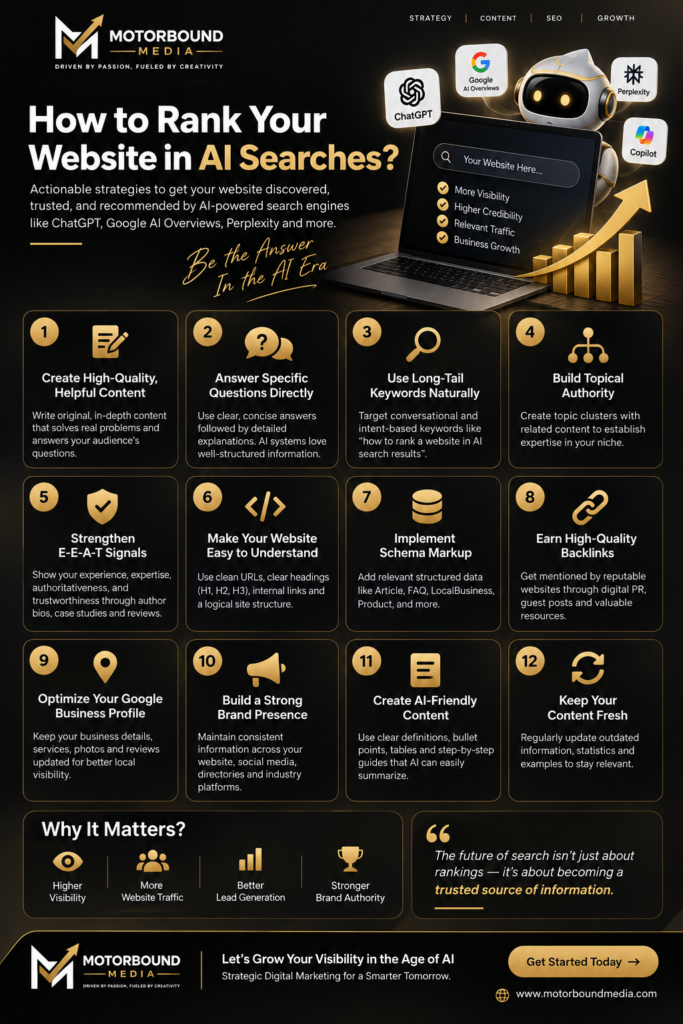
Search is changing fast. People are no longer relying only on Google to find information. They are increasingly asking AI platforms such as ChatGPT, Google AI Overviews, Microsoft Copilot, and Perplexity to research products, compare services, find businesses, and answer complex questions. This creates a new opportunity for website owners: getting their content discovered and mentioned in AI-generated answers. But ranking in AI search isn’t simply about stuffing your pages with keywords. AI systems need to understand your content, determine whether your website is trustworthy, and decide whether your information is useful enough to include in an answer. So, how do you rank your website in AI searches? Let’s break it down. What Is AI Search Optimization? AI search optimization is the process of improving your website so that AI-powered search engines and answer engines can easily discover, understand, trust, and reference your content. Traditional SEO focuses heavily on ranking webpages in search engine results pages (SERPs). AI search optimization goes one step further. Instead of asking: “How can I get my page to rank #1?” You should also ask: “How can I make my website a reliable source that AI systems want to mention?” This approach is often associated with terms such as Generative Engine Optimization (GEO), AI SEO, Answer Engine Optimization (AEO), and Large Language Model Optimization (LLMO). Why Ranking in AI Search Matters Imagine someone asks an AI assistant: “What is the best digital marketing agency in Delhi for SEO and social media marketing?” The AI may provide a short list of agencies instead of displaying ten blue links. If your company isn’t represented in those answers, you could miss potential customers—even if your website ranks reasonably well in traditional search. AI search can influence: This is why businesses should start optimizing for both traditional search engines and AI-powered search experiences. How to Rank Your Website in AI Searches 1. Create High-Quality, Helpful Content The foundation of AI search optimization is still good content. AI systems need useful information to answer users’ questions. If your website provides clear, accurate, original information, it has a better chance of becoming a useful source. Instead of creating articles simply to target keywords, focus on solving real problems. For example, rather than writing: “SEO Services – Best SEO Company – SEO Agency – SEO Expert” create a detailed resource such as: “How to Improve Local SEO for a Small Business: 10 Practical Strategies” Cover the topic thoroughly and answer the questions your target audience is actually asking. Long-tail keyword example: “how to improve local SEO for a small business in Delhi” Long-tail keywords can help you target specific search intent while naturally creating content that answers detailed questions. 2. Answer Specific Questions Directly AI search is heavily question-driven. Users ask things like: Your content should provide clear answers. A useful structure is: Question How long does SEO take to show results? Direct answer SEO typically takes several months to produce meaningful results, although the timeline depends on competition, website authority, technical health, content quality, and the strategies being implemented. Then expand on the answer with supporting details. This makes your content easier for both users and search systems to understand. 3. Use Long-Tail Keywords Naturally Long-tail keywords are especially useful for AI-focused content because conversational searches tend to be more specific. Instead of targeting only: AI SEO consider targeting variations such as: Don’t force these keywords into every paragraph. Use them where they naturally match the search intent. 4. Build Strong Topical Authority One article usually isn’t enough to establish expertise around a subject. Suppose you run an SEO agency. Instead of publishing one article about SEO, create a collection of interconnected resources: Main Topic SEO Services Supporting Topics This creates a topic cluster. When multiple high-quality pages cover related subjects, search engines and AI systems can better understand what your website specializes in. 5. Strengthen Your E-E-A-T Signals Trust matters. Google’s search guidelines emphasize Experience, Expertise, Authoritativeness, and Trustworthiness (E-E-A-T), and these principles are highly relevant when creating content intended to be surfaced in AI-driven search experiences. Show readers that real people with relevant knowledge are behind your content. You can strengthen these signals by including: Don’t simply claim that you’re an expert. Demonstrate it through your content. 6. Make Your Website Easy for AI to Understand AI systems need to interpret your website’s content. A technically clean website makes this easier. Pay attention to: Clear headings Use a logical hierarchy: H1 → H2 → H3 Avoid using headings randomly. Descriptive URLs Prefer: /ai-search-optimization/ over: /page?id=12345 Internal links Connect related pages using descriptive anchor text. For example: AI SEO strategies is more informative than: click here Structured content Use: Well-structured information is easier to scan and interpret. 7. Implement Schema Markup Schema markup provides structured information about your webpage. Depending on the content, relevant schema types can include: Schema doesn’t guarantee that your content will appear in AI answers. However, accurate structured data can help search engines better understand entities, relationships, and page information. Important: Your structured data should accurately represent visible content on the page. Don’t add misleading or irrelevant schema simply to manipulate search results. 8. Earn High-Quality Backlinks and Mentions Authority isn’t built only on your own website. When reputable websites mention and link to your business, they can reinforce your online authority. Focus on earning relevant links through: The goal isn’t to collect hundreds of random backlinks. The goal is to become a recognized entity within your industry. For example, if multiple trustworthy websites consistently discuss a company as a leading SEO agency, that broader web presence can contribute to how search systems understand the company. 9. Optimize Your Google Business Profile for Local Visibility If your business serves a particular city or region, local SEO becomes extremely important. Keep your Google Business Profile accurate and updated with: Also maintain consistent business information across relevant online directories. For a local business, your goal isn’t only to rank your website. You want search systems to clearly
How to Rank Your Website in AI Searches: A Complete Guide for 2026 Read More »