
AI Marketing vs Traditional Marketing: What Businesses Should Use in 2026?
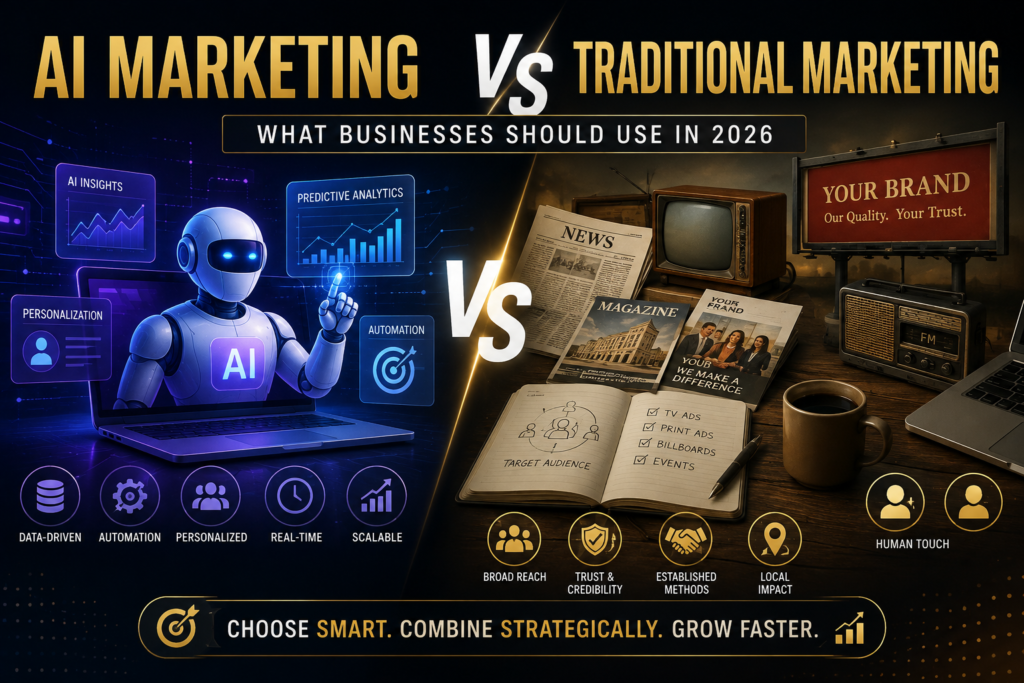
AI Marketing vs Traditional Marketing: What Businesses Should Use in 2026?
Marketing is changing faster than ever.
For decades, businesses relied on traditional marketing channels such as television, newspapers, radio, billboards, direct mail, events, and print advertising to reach customers.
Then digital marketing transformed the industry.
Search engines, social media, email marketing, websites, and online advertising gave businesses the ability to reach highly targeted audiences and measure results more precisely.
Now, another major shift is happening: artificial intelligence is becoming part of the marketing process.
Businesses can use AI to analyze customer behavior, personalize campaigns, generate content, automate repetitive tasks, predict trends, and improve advertising decisions.
But this raises an important question:
The answer isn't simply AI vs traditional marketing.
For most businesses, the smarter strategy is to understand where each approach works best and combine them strategically.
What Is AI Marketing?
AI marketing refers to using artificial intelligence technologies to improve different parts of the marketing process.
AI can help businesses with:
- Customer research
- Content creation
- Audience segmentation
- Personalization
- Predictive analytics
- Advertising optimization
- Chatbots and customer support
- Marketing automation
- Data analysis
- Lead qualification
For example, instead of manually analyzing thousands of customer interactions, an AI-powered system can identify patterns and help marketers understand what customers are interested in.
AI can also help generate multiple versions of an advertisement, analyze campaign performance, or personalize messages for different audiences.
What Is Traditional Marketing?
Traditional marketing refers to established offline marketing channels that existed before the rise of digital platforms.
Examples include:
- Television advertising
- Radio
- Newspapers
- Magazines
- Billboards
- Flyers
- Direct mail
- Events
- Trade shows
- Outdoor advertising
These channels can still be effective, particularly when a business wants to create broad awareness or reach a specific local audience.
Traditional marketing hasn't disappeared.
Instead, its role is changing.
AI Marketing vs Traditional Marketing
Let's compare the two approaches.
| Factor | AI Marketing | Traditional Marketing |
|---|---|---|
| Targeting | Highly targeted | Often broader |
| Personalization | Very high | Limited |
| Automation | High | Low |
| Data Analysis | Advanced | More difficult |
| Real-time Optimization | Yes | Limited |
| Human Interaction | Can be limited | Often strong |
| Local Physical Presence | Limited | Strong |
| Measurement | Usually easier | Often harder |
Neither side wins every category.
The right choice depends on your business, audience, budget and objectives.
1. AI Marketing Gives Businesses Better Personalization
One of the biggest advantages of AI marketing is personalization.
Instead of showing exactly the same message to everyone, businesses can use data and AI-powered systems to create experiences based on:
- Previous interactions
- Customer interests
- Browsing behavior
- Purchase history
- Demographics
- Location
- Engagement patterns
Imagine an ecommerce company with thousands of customers.
Instead of sending everyone the same promotional email, the business could create different customer segments and deliver more relevant recommendations.
This can make marketing more relevant and potentially improve engagement.
2. Traditional Marketing Still Has Something AI Can't Easily Replace
Despite the growth of AI, traditional marketing has one major advantage:
Physical human presence.
A billboard in a busy location.
A business sponsoring a local event.
A salesperson meeting a potential customer.
A brand appearing on television.
A company exhibiting at an industry conference.
These experiences can create familiarity and trust in ways that digital interactions sometimes struggle to replicate.
3. AI Can Analyze Marketing Data Faster
Modern marketing produces enormous amounts of data.
Businesses can collect information from:
- Websites
- Search campaigns
- Social media
- Ecommerce platforms
- Advertising platforms
- Customer interactions
Analyzing all of this manually can take considerable time.
AI can help identify patterns and trends within large datasets much faster.
AI provides speed and scale.
The marketer provides judgment and strategy.
4. Traditional Marketing Can Build Broad Awareness
Not every marketing campaign needs to target an individual customer.
Sometimes the objective is simply:
This is where traditional mass-media marketing can still be useful.
A memorable billboard, television advertisement or event sponsorship can expose a brand to thousands or even millions of people.
5. AI Makes Content Production Faster
Content marketing has traditionally required significant time.
A single campaign might involve:
- Research
- Copywriting
- Graphic design
- Video production
- Editing
- Distribution
- Performance analysis
AI tools can accelerate many of these tasks.
For example, marketers can use AI to help:
- Brainstorm campaign ideas
- Create content outlines
- Generate draft copy
- Repurpose long-form content
- Analyze customer feedback
- Create variations of advertisements
- Summarize research
- Generate content calendars
6. AI Marketing Can Improve Advertising Optimization
Digital advertising platforms already use sophisticated machine-learning systems to optimize campaigns.
AI-assisted marketing can help businesses analyze:
- Cost per click
- Cost per lead
- Conversion rates
- Customer segments
- Creative performance
- Campaign performance
- Return on advertising spend
This makes it possible to continuously test and optimize campaigns.
Advertisement A: 100,000 impressions → 50 leads
Advertisement B: 100,000 impressions → 82 leads
Instead of simply choosing the advertisement with more clicks, a marketer can investigate which version actually produces better business results.
Marketing should optimize for business outcomes, not vanity metrics.
7. Traditional Marketing Can Create Stronger Offline Trust
Digital advertising can sometimes feel impersonal.
People see thousands of online advertisements every day.
Traditional marketing can sometimes create a stronger sense of legitimacy simply because the brand appears in the physical world.
8. AI Doesn't Mean You Should Stop Using Humans
This is perhaps the biggest misconception about AI marketing.
Some businesses think:
That's the wrong way to think about it.
AI can process information quickly.
But businesses still need people to decide:
- What should the brand stand for?
- Who should we target?
- What problem are we solving?
- What should we say?
- What shouldn't we say?
- Which opportunities are worth pursuing?
- Does this campaign actually represent our brand?
AI can generate ten campaign concepts.
A human still needs to decide which one deserves to exist.
9. So, Which Is Better in 2026?
For most businesses:
Neither one alone.
The strongest approach is usually a hybrid marketing strategy.
The Best Strategy: Combine Both
Instead of choosing AI OR Traditional, build:
Use AI to:
- Research the market
- Analyze audiences
- Create content drafts
- Optimize campaigns
- Personalize customer experiences
- Analyze performance
Then use digital channels such as:
- SEO
- Google Ads
- Social media
- Email marketing
- Content marketing
- AI-search optimization
At the same time, use traditional marketing where it makes sense:
- Events
- Outdoor advertising
- Partnerships
- Local sponsorships
- Networking
- Physical branding
When Should You Prioritize AI Marketing?
AI-driven marketing should probably receive more attention if your business:
- Operates primarily online
- Needs measurable lead generation
- Runs paid advertising
- Has a large customer dataset
- Needs personalized marketing
- Produces lots of content
- Wants marketing automation
- Sells through ecommerce
- Wants to scale campaigns efficiently
When Should You Prioritize Traditional Marketing?
Traditional marketing can make more sense when your business:
- Serves a local audience
- Depends on physical locations
- Benefits from events
- Needs broad awareness
- Targets audiences that consume traditional media
- Relies heavily on face-to-face sales
- Operates in industries where physical credibility matters
A Simple 2026 Marketing Framework
Social media + SEO + advertising + traditional media
Content + video + website + educational resources
Landing pages + forms + calls + WhatsApp + email
CRM + automation + AI-assisted segmentation
Sales + remarketing + personalized communication
Email + social media + customer support + loyalty campaigns
Analytics + AI-assisted insights + conversion data
Improve the strategy based on actual results.
What Businesses Should NOT Do in 2026
Don't adopt AI simply because everyone is talking about it.
Don't automate everything.
Don't publish hundreds of low-quality AI articles.
Don't abandon traditional marketing without understanding your audience.
Don't judge marketing success only by likes and impressions.
Ask yourself:
Does this technology help us reach the right customer, communicate our value better, or generate better business results?
The Future Isn't AI vs Humans
The future of marketing isn't really:
AI vs Traditional Marketing
or even:
AI vs Humans.
It's about humans using technology intelligently.
AI can provide speed.
Traditional marketing can provide physical presence.
Digital marketing can provide targeting and measurement.
Human marketers provide creativity, judgment, empathy and strategy.
Put them together and businesses can build something much more powerful than any individual channel.
Final Thoughts
AI marketing is not here to completely replace traditional marketing in 2026.
Instead, it's changing how businesses plan, execute and measure marketing.
The smartest businesses won't ask:
“Should we use AI or traditional marketing?”
They'll ask:
“Which combination of channels will help us reach our customers most effectively?”
For some businesses, that might mean investing heavily in AI-powered digital marketing.
For others, traditional advertising may remain an important part of the strategy.
For many businesses, however, the winning formula will be:
Use AI where it creates efficiency.
Use digital channels where precision and measurement matter.
Use traditional marketing where physical presence and broad awareness create value.
And put human strategy at the center of everything.
Because in 2026, the businesses that win won't necessarily be the ones using the most AI.
They'll be the ones using the right technology, through the right channels, for the right customers.
Ready to Build a Smarter Marketing Strategy?
At MotorBound Media, we help businesses build stronger digital presence through SEO, AI-focused marketing, social media marketing, paid advertising, content strategy, lead generation and web development.
Whether your business needs more visibility, more leads or a stronger online presence, the right marketing strategy starts with understanding where your customers are and how they make decisions.
GET STARTED →